

By Ruth Ross
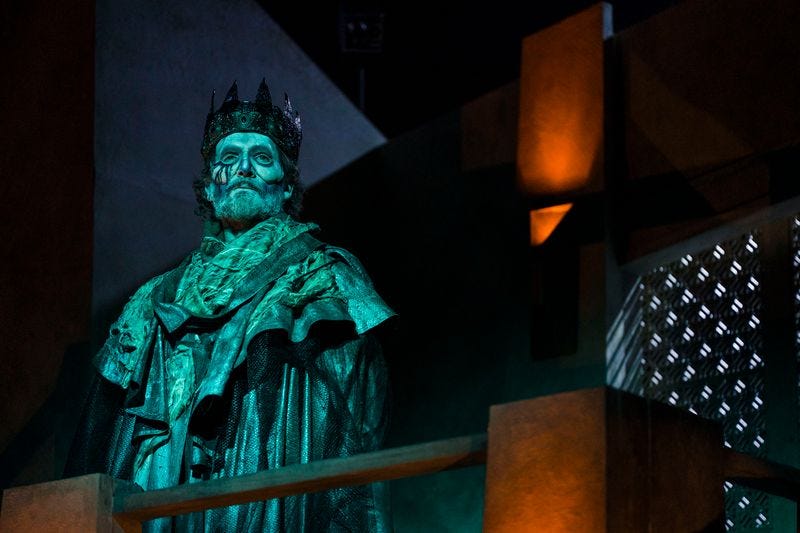
Just in time for Halloween, the Shakespeare Theatre of New Jersey has mounted a spooky production of what is perhaps The Bard’s most famous play, Hamlet.
I use the word “spooky” to describe this production in tribute to Drew Sensue-Weinstein’s effective, imaginative sound design, complete with ominous rumbling one can feel in the feet and tummy, unexpected claps of thunder, and the echo-y voice of the dead King’s ghost. It scares the audience as much as it does watchmen Bernardo and Marcellus and the Prince’s friend Horatio, and it sets the atmosphere for the remainder of the play.
Considered a tragedy by most, it is perhaps Shakespeare’s most psychological play—although he might have considered it a study of human nature, given that the term psychology didn’t exist in his time. In his other well-known tragedy, Macbeth, it’s pretty clear why, after his bravery in helping put down a civil war, Macbeth is so angry at being denied the title of heir to the Scottish crown that he kills King Duncan (and the collateral lives he snuffs out afterward).
But Prince Hamlet’s predicament and remedy are an entirely different matter.
If you don’t know the basic story outlines of the play, Prince Hamlet’s father, the King of Denmark, has died unexpectedly. Instead of the kingship’s being bestowed on his heir, Hamlet’s uncle Claudius has ascended the throne and swiftly married the widow Gertrude, the Prince’s mother. When a ghost claiming to be the late king tells the grief-stricken Hamlet that Claudius murdered him with poison and demands revenge, Hamlet feigns madness to investigate the claim. What ensues is murder, death by drowning, and a rigged fencing match against Hamlet using a poisoned blade and poisoned wine. Not to spoil things, but at the end, all the main characters, except Horatio, are dead, as befits a tragedy.
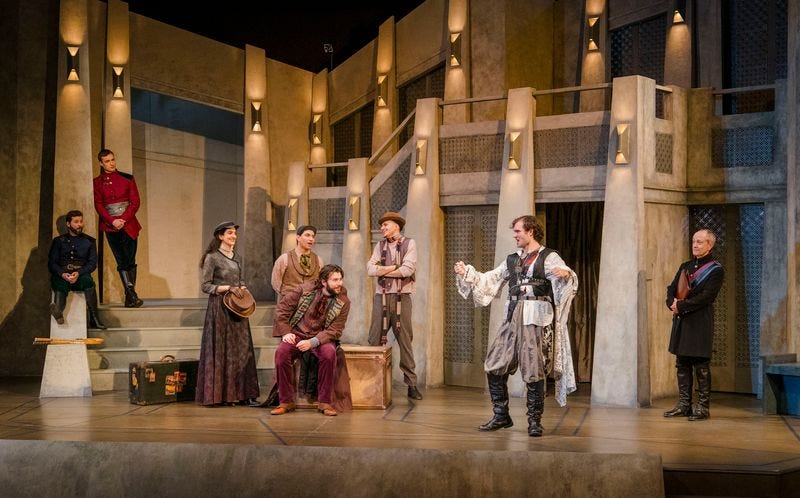
Under Brian Crowe’s astute direction, the action inexorably unfolds on Brian Ruggaber’s set reminiscent of post-war Brutalist architecture, eerily lit by Andrew Hungerford. Crowe has set the action in a mishmash of historical periods; it’s great fun to look for the Easter eggs denoting each era! And I was struck this time by how much “sex” is the focus of the play, from Hamlet’s disgust imagining his mother’s sexuality to his excoriation of the virgin Ophelia to “get … to a nunnery” to remain pure to the frat-bros’ horsing around of Rosencrantz and Guildenstern (Dino Curia and Neil Redfield, respectively)—complete with double entendres and a lot of crotch grabbing—to Polonius’ explicit admonitions to his daughter Ophelia to avoid Hamlet’s advances lest it sully her (and his) reputation.


Isaac Hickox-Young delivers a very convincing, human performance as the grief-stricken 20-year-old prince. His delivery of the character’s famous soliloquies that give us a glimpse into his inner turmoil are conversational, rather than declamatory. Of course, the scheme to feign madness to suss out the truth of his father’s death is nutty, but it sure gives the actor a wide range of emotions to evoke. He’s well matched by Billie Wyatt as a luminous Ophelia; her innocence is palpable and heart wrenching, especially in her (real) mad scene where, in tattered garments, she rants and raves nonsense that, ironically, makes sense. Indeed, these two young actors at the center of the plot steal the show from the older adults.
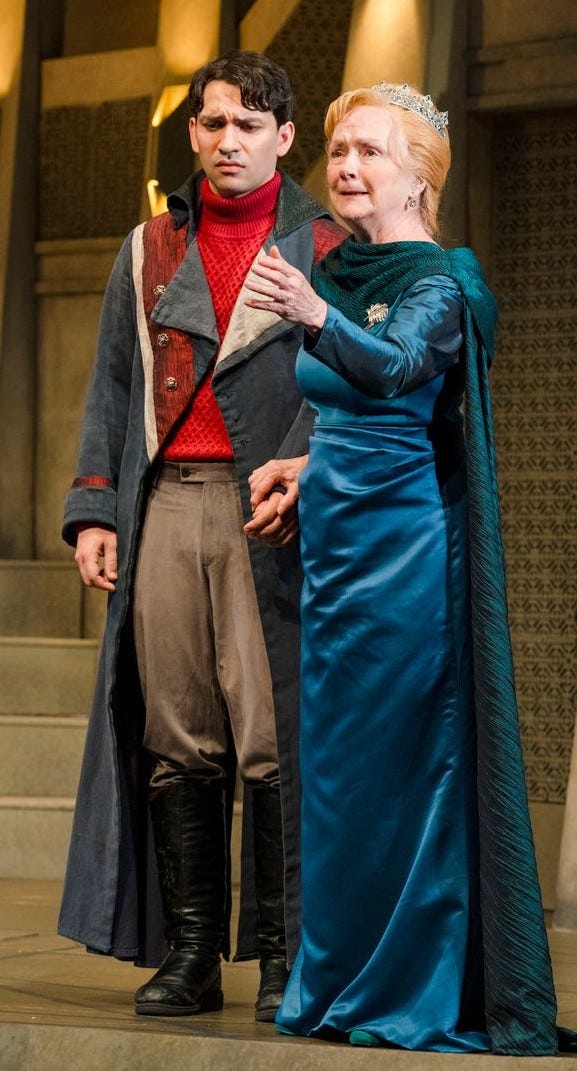
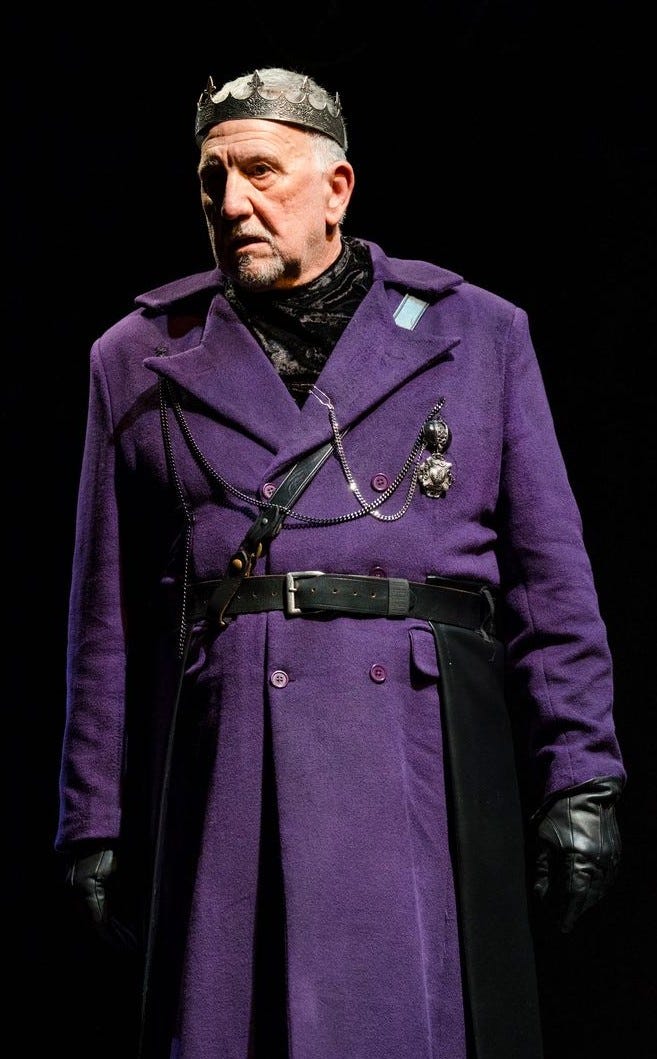
These include Marian Adler as Queen Gertrude and Scott Wentworth as Claudius. They are the oldest actors I have seen cast in these roles; Wentworth looks a bit old to be King Hamlet’s younger brother (the “spare”) as is Adler to be the mother of a college student, especially in an age when women often wed at 14 or 15. Nevertheless, the two turn in superb performances: Wentworth’s Claudius is ruthless and sly, someone to be feared, while Adler’s Gertrude is flighty and often confused by her son’s anger and grief.
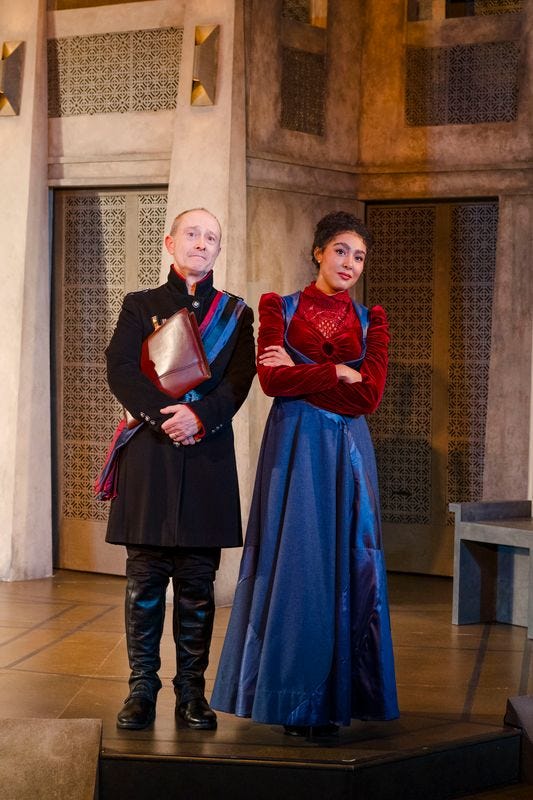
And Andrew Sellon (above, with Wyatt) is especially grand as the blowhard Polonius, eliciting titters and exasperation from the audience—and eyerolls from his children Ophelia and Laertes—from his long-winded advice and the unctuous amount of bootlicking he does to ingratiate himself with Claudius.
Equally fine support is provided by Ty Lane as Laertes and Joe Muccioilo as Hamlet’s buddy Horatio. The latter is the voice of reason, the former the voice of wild grief and revenge. In the final scene, Lane shows he has the chops to duel, with Hickox-Young as a worthy opponent.
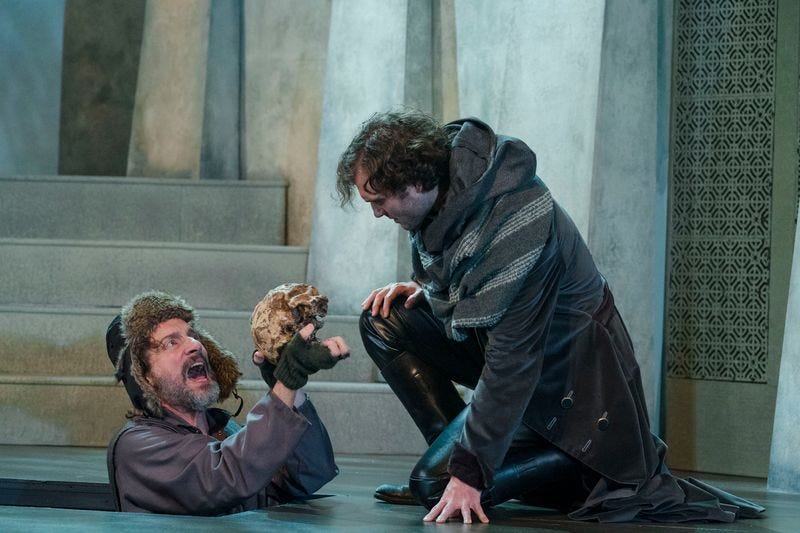
Others worth mentioning are Ethan Goodmansen as the Player King, along with Clara Chahine and Cole Henry Gilder as his fellow actors in The Mousetrap, the play presented to the court to trap Claudius for his crime. And finally, one cannot ignore the performance by Anthony Marble as a very spooky King Hamlet and later as the merry gravedigger. Marble (above), a veteran of STNJ productions, plays both sides of the coin with eeriness and zest!
Kudos to the production team of Hamlet. In addition to those mentioned, Yao Chen is to be commended for the wide range of styles and materials used for the costumes. Dressing Ophelia, Polonius, and Laertes in the same colors cements their familial relationship; Hamlet’s black leather and velvet attire signify his grief while Claudius’ purple coat signifies his royalty and Gertrude’s teal gown makes her stand out among the men. Whoever was in charge of the props also deserves praise; they are part of the Easter eggs Crowe has dropped into this somber revenge play. Look for them!
The world of Hamlet is one of dissembling, espionage, revenge and distrust, a world that resonates with modern audiences given today’s political and social climate. But above all, it is the story of three young people betrayed by the parents they trusted to protect them and by a world of intrigue they don’t quite understand.
This production of Hamlet is the most inventive I have ever seen—well acted, cleverly staged without being precious, a tale for our time. You will want to see it. And don’t forget to bring your teenagers with you. After all, Shakespeare’s plays were meant to be acted, not read. Attending a performance will be life-changing for the young folk. They may even fall in love with Shakespeare!
Hamlet will be performed at the F.M. Kirby Shakespeare Theatre on the campus of Drew University, 36 Madison Ave., Madison, through November 15, 2026. For information and tickets, call the box office at 973.408.5600 or visit www.ShakespeareNJ.org online.
Photos by Avery Brunkus.